

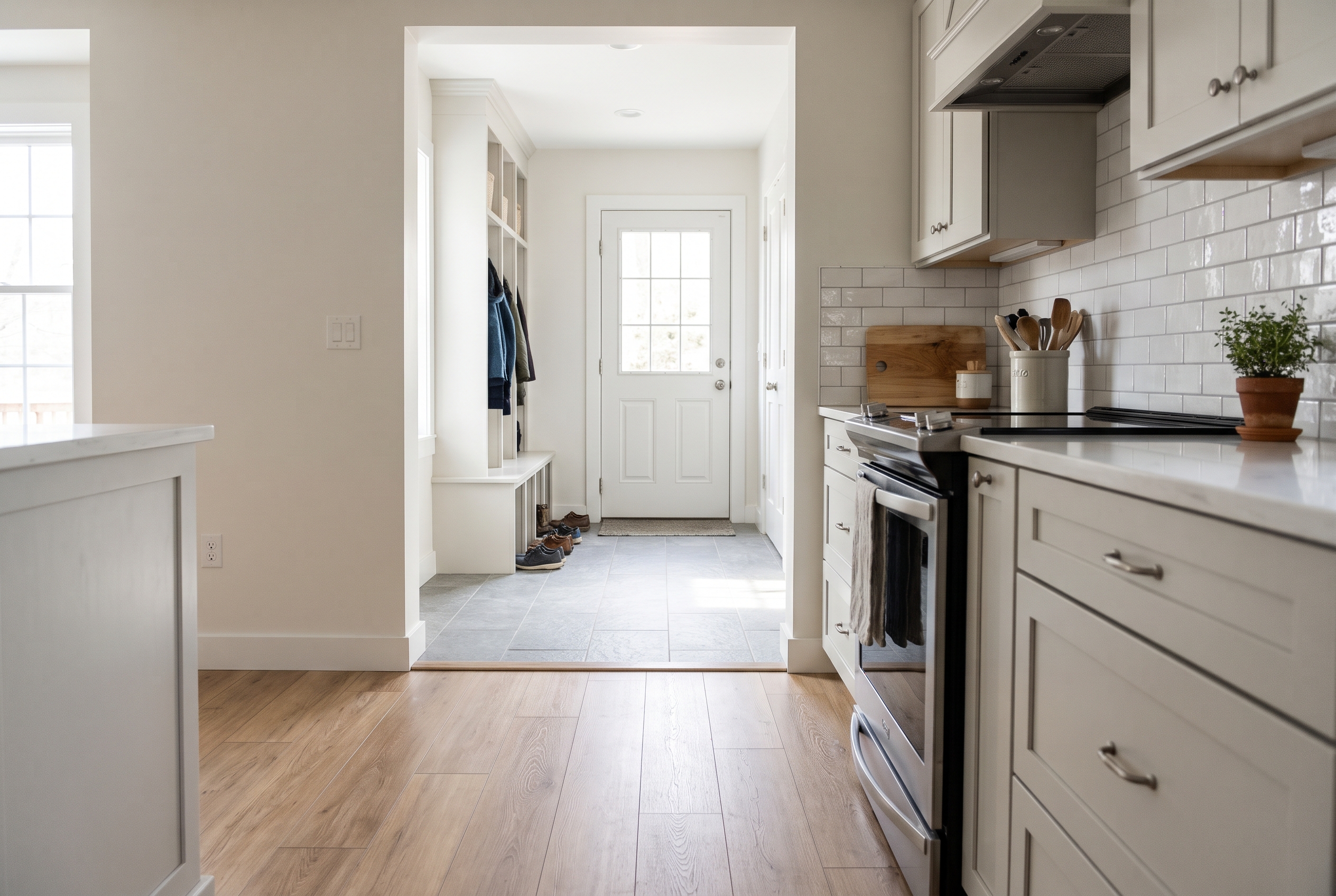
Porcelain is the better tile wherever water, grit or heavy traffic reaches the floor: kitchens, entries, shower floors and covered patios. Ceramic does just as well on walls, backsplashes and the floors of bedrooms and lightly used bathrooms. It's also easier to cut and generally costs less, as long as the box says it's made for floors.
| Room | Better choice | Why |
|---|---|---|
| Kitchen floor | Porcelain | Dropped pans, grit and spills |
| Family bathroom floor | Porcelain or floor-rated ceramic | Water and wet feet every day |
| Powder room or guest bath floor | Either one | Light traffic |
| Shower floor | Porcelain mosaic or textured porcelain | Constant water and bare feet |
| Shower walls and tub surround | Either one | Water but no foot traffic |
| Backsplash and walls | Ceramic | Light, easy to cut, more glazes |
| Entry, mudroom or laundry room | Porcelain | Grit and wet shoes |
| Living areas and bedrooms | Either one | Lighter traffic and softer shoes |
| Covered patio | Porcelain rated for exterior use | Rain, freezes and wet feet |
What Is the Difference Between Porcelain and Ceramic Tile?
Porcelain is a kind of ceramic tile, and the difference between them is the clay and the heat. Among the tile makers we carry, Daltile describes porcelain as ceramic made from a finer clay mixture and fired at much higher temperatures. That leaves it denser, harder and less porous. Everyday ceramic tile is clay, sand and water fired at lower heat, which gives a slightly softer body that's easier to cut.
The dividing line is a number. By the definition the Tile Council of North America (TCNA) uses, porcelain absorbs 0.5% of its weight in water or less in a standard soak test. Tile that absorbs more is non-porcelain, which the trade calls ceramic. Some tile is sold as porcelain without meeting that standard, but a tile carrying the Porcelain Tile Certification Agency (PTCA) mark has been certified as true porcelain.
Both kinds come glazed or unglazed. A glaze is a glassy layer fired onto the face, and it carries the color and pattern. Most ceramic tile is glazed, with unglazed quarry tile the usual exception.
Porcelain comes both ways, and two kinds matter on a floor. Through-body porcelain is unglazed, so its face color runs all the way through. Color-body porcelain has a glazed face over a body tinted to match.
How Can You Tell Porcelain From Ceramic Tile?
You can tell porcelain from ceramic by the label, by the back and edge of a loose tile, or by a chip on a floor that's already down. The label is the surest of the three.
- Read the label. Look for the word porcelain with a water absorption of 0.5% or less, the class "impervious" or the PTCA mark. A box marked as wall tile, or one with no floor rating, isn't meant for a floor.
- Turn a loose tile over. Ceramic usually shows a red, tan or white clay back that looks chalky, and the tile feels light for its size. A porcelain back is finer and denser, and the tile feels heavy in your hand.
- Look at a broken or cut edge. Through-body porcelain shows the face color all the way through, and color-body porcelain shows a body close to it. Glazed ceramic and some glazed porcelain show a different color under a thin glaze.
- Put a few drops of water on the unglazed back. A ceramic body darkens as it soaks the water in, while a porcelain body barely changes. It's a rough test, but it follows the absorption numbers.
On an installed floor, look where the body shows: a chipped corner, a tile cut at a floor vent or the edge under a doorway transition. Leftover boxes in the garage or attic often name the line, and the line's product page names the material.
Knowing which one you have matters most when a tile cracks. A replacement has to match the body as well as the face, or a later chip in it will show a different color. With no spare on hand, a tile from inside a closet or under the refrigerator can be moved to the spot that shows. It also matters outdoors, where only tile rated for exterior use belongs, and when you drill, since porcelain needs a bit made for it.
Is Porcelain Tile Stronger Than Ceramic, and Which One Chips?
Porcelain is the stronger, harder body and less likely to chip. Whether a chip shows, though, depends on how the tile is made, and on a busy floor that counts for more.
A glazed tile, ceramic or porcelain, carries its color in a thin layer on top. A chip breaks through that layer and shows the body underneath, often in a different color. On color-body porcelain, the body is tinted close to the face, so a small chip shows less. Through-body porcelain has the same color all the way through, and it hides chips and wear even in hard use.
A good glaze still holds up, and most glazed porcelain goes years in an ordinary home without showing wear. Glazes differ from tile to tile, though. The wear rating on the box tells you whether a glaze is made for floors.
Breaking strength is listed in pounds: the force it took to break an unsupported tile in a lab test. On a floor, support matters more than that number. A tile with hollow spots under its corners can crack when a heavy pan lands on it, porcelain included. Set on full mortar coverage, the same tile is far less likely to crack.
Scratches come from grit under shoes and chair legs. Scratch hardness is rated on the Mohs scale, from talc at 1 to diamond at 10, and a tile rated 5 or higher suits most home floors. A matte or textured face hides fine scratches better than a polished one.
Porcelain's drawbacks show up in the installation. It's harder to cut and drill, heavier to carry and set, and harder for mortar to grip, so the labor can cost more. You may also read that porcelain is brittle. Any tile, porcelain or ceramic, cracks when the floor under it bends or moves.
What Does the PEI Rating Mean on Porcelain and Ceramic Tile?
The PEI rating on porcelain and ceramic tile is a wear rating for the glaze. It's an abrasion class from 0 to 5, tested under ASTM C1027, a method written for glazed tile. The class tells you how much foot traffic and grit a glaze can take before the wear shows. Here's how the classes line up with rooms:
- Class 0 isn't meant for any floor.
- Class 1 suits bathrooms and bedrooms with no outside door, where shoes are soft and grit is rare.
- Class 2 suits living areas, though not kitchens or entries.
- Class 3 suits kitchens and hallways.
- Class 4 suits entries and other floors with heavy traffic and tracked-in grit.
- Class 5 is meant for heavy commercial floors.
Ceramic sold as wall tile may carry class 0 or no floor rating at all, and it belongs on the wall. Unglazed through-body porcelain has no glaze to wear through. It's tested for deep wear by a different method, so it may carry no PEI class. Claims that most porcelain is "PEI 5" mix the two up, because the class describes a glaze, and a glazed porcelain's class is whatever its glaze earned.
Is Porcelain Tile Waterproof, and Does It Matter?
No, but it comes close. Porcelain absorbs 0.5% of its weight in water or less, so it's nearly impervious, and ceramic bodies absorb more. Inside a house, the difference matters less than you might expect. A glazed ceramic floor keeps spills on its surface, and the water that gets past any tile floor goes through the grout.
Tile is sorted by how much water its body takes on. Impervious tile absorbs 0.5% or less, and that's porcelain. Vitreous tile absorbs more than 0.5% and up to 3%, semi-vitreous more than 3% and up to 7%, and non-vitreous more than 7%. The lower the number, the less water the body can hold.
Absorption matters most outdoors, where water soaked into a tile body expands when it freezes and can crack or flake the tile. Porcelain is usually frost resistant because it absorbs so little, though not always, so check the maker's rating before it goes outside. Unglazed tile is the other case, since it has no glassy face to keep a spill on the surface.
Neither tile makes a shower waterproof. TCNA points out that glazed tile stops water vapor but cement grout passes water and vapor easily. The waterproofing in a tiled shower is a membrane under the tile, covering the whole tiled area, and a steam shower needs one that meets ANSI A118.10. With that layer in place, porcelain and ceramic both make sound shower walls.
Is Porcelain or Ceramic Tile More Slippery?
Neither one is more slippery by nature, because grip comes from the finish and the body has little to do with it. A polished porcelain is slick when it's wet, while a matte or textured ceramic can grip well. Unglazed porcelain often grips better than glazed tile. Keep polished tile out of rooms where water, oil or grease can reach the floor.
The number to look for on the spec sheet is the wet DCOF, short for dynamic coefficient of friction. It measures grip on a wet tile in a standard test. The national tile standard, ANSI A137.1, requires a wet DCOF of 0.42 or more for tile sold for level indoor floors that get walked on when wet. A floor that stays wet under bare feet, like a shower floor, calls for more grip than that minimum.
No tile is slip proof, but smaller tiles help on a wet floor, because the extra grout joints drain water away and give your foot more to catch on. In a home with young children, older adults or a dog that skids, choose slip-resistant tile for every floor that gets wet, from the bathroom to the back door.
Where Does Porcelain Beat Ceramic, Room by Room?
Water, grit, heavy traffic and the outdoors decide which tile a room needs, and each of them points to porcelain. Where none of them reaches, ceramic performs just as well and costs less.
Daltile draws the line in the same place. It names shower floors, outdoor patios and the main floors of kitchens, bathrooms, halls and entries as porcelain's best uses. For ceramic, it names walls, backsplashes and light-traffic floors such as powder rooms and guest baths.
Should a Kitchen Floor Be Porcelain or Ceramic?
It depends on how hard your kitchen works: in a busy kitchen porcelain is the better floor, and in a quiet one a floor-rated ceramic does fine. A kitchen takes dropped pans, chair legs, grit from the back door and spills at the sink. A chip shows least on color-body or through-body porcelain. For a lightly used kitchen on a budget, look for a glazed ceramic with a wear class of 3 or higher.
Choose a matte or lightly textured face, which cuts the glare under kitchen lights and grips when something spills. A mid-tone tile and grout hide crumbs between mops. Larger tiles mean fewer grout lines to clean, but they need a flatter floor, so a slab with dips may limit how big you go. When new tile is part of a kitchen and bath remodeling project with us, we help you choose it with the cabinets, counters and lighting in view.
Is Porcelain or Ceramic Better for a Bathroom Floor?
The choice depends on how often the bathroom gets wet: porcelain for a bath used every day, and a floor-rated ceramic for a powder room or a guest bath. A family bath takes splashes from the tub, wet feet and frequent mopping, and porcelain's dense body handles that best. Either tile does well when it's rated for floors and grips when wet.
Check the wet DCOF on the spec sheet, and choose a matte or textured face over a polished one. Smaller tiles in front of the tub and around the toilet add grip and follow any slope in the floor. A bathroom with an outside door, such as one off a pool, takes grit like an entry and wants a wear class of 4. A grout a shade darker than the tile keeps the joints from looking dingy.
Should You Use Porcelain or Ceramic Tile in a Shower?
It depends on the surface: use porcelain on the shower floor and either tile on the walls. Ceramic is a common wall choice because it's lighter on a vertical surface, cuts easily around valves and niches, and comes in more glazes. The shower floor takes constant water and bare feet. Small porcelain mosaics or a textured porcelain give the grip there, and their grout joints help the floor slope to the drain.
A center drain needs small tile, because the floor slopes toward it from every side. A linear drain along one wall lets the floor slope one way, so larger tile can run into the shower, even your bathroom floor tile if it's rated for shower floors. We also carry Marazzi, and its product pages mark the tiles that meet its shower-floor criteria with an icon.
Whichever tiles go on the walls and floor, the waterproof membrane under them keeps the water in the shower. A steam shower also needs tile its maker recommends for steam rooms. We build custom showers and tub surrounds, from walk-in showers to tiled tub surrounds.
Which Tile Works Best for a Backsplash or Wall?
When nothing walks on the surface, ceramic is usually the better value, and it's the usual tile for a backsplash or wall. It's lighter, cuts cleanly around outlets and window trim, and comes in brighter glazes and more surface patterns. Porcelain works on walls too, mostly to match a porcelain floor or for large panels.
A glossy glaze reflects light and wipes clean behind a range or sink. Wall tile with no floor rating is fine here, since nothing walks on it, but keep it off the floor. Large porcelain panels on a wall need a mortar and a backing made for their weight.
Which Tile Stands Up Best in an Entry, Mudroom or Laundry Room?
When grit and water come through the door every day, porcelain stands up best, whether the room is an entry, a mudroom or a laundry room. Grit carried in on shoes grinds at a glaze, and wet boots, dog bowls and a leaking washer leave water on the floor. A matte or textured porcelain with a wear class of 4, the class for entrances, handles both.
Put a mat inside the door to catch grit before it reaches the tile. Red clay tracked in after a rain is the hardest test here, and darker grout hides it best on entryway and mudroom floors. In a laundry room, run the tile under the washer so a leak lands on tile.
Does It Matter Which Tile You Use in Living Areas and Bedrooms?
That depends on the traffic, and in living areas and bedrooms it's light enough that either tile works. The choice matters less here than anywhere else in the house. A floor-rated ceramic with a wear class of 1 suits a bedroom, and class 2 suits a living room. Porcelain is the better choice where a living area opens onto the kitchen or a back door.
Wood-look porcelain is a popular choice for open living spaces. Monochrome wood-look porcelain carries one color family through the kitchen, living room and halls. Any tile is cool underfoot, which a Texas summer makes welcome, and rugs or radiant heat take care of winter.
Can Porcelain or Ceramic Tile Go on a Covered Patio?
Yes, if the tile is rated by its maker for exterior use, and porcelain is the safe choice. Rain blows in, and North Texas gets a hard freeze some winters. Water that soaks into a tile body or sits in its joints can crack the tile when it freezes. Some ceramic is rated for exteriors too, quarry tile among it, so check the maker's area-of-use rating.
Marazzi marks exterior-rated tile with its own icon and recommends a wet DCOF of 0.60 or more on patios, so pick a textured finish. Set the tile in mortar rated for exterior use, with movement joints so the slab and tile can shift with the weather. Slope the surface so water drains off before it can sit in the grout.
Are Wood-Look and Large-Format Tiles Usually Porcelain?
Yes, almost always. The dense porcelain body holds up in long planks and big squares, and it takes printed wood, marble and concrete looks well. Tile larger than 15 inches on a side is called large format.
Size changes the installation more than the tile. Thinset mortar follows the floor beneath it and can't flatten it, so a big tile shows every hump and dip as lippage, where one edge stands higher than the next. Light from a patio door and a glossy face make lippage easier to see. A large-format floor needs a flatter base than small tile, a mortar made for large and heavy tile, and full coverage under every corner.
Long wood-look planks are usually laid with a short offset, often a third of the plank or less, because long tiles have a slight bow that a half offset turns into lippage. Many large tiles also have rectified edges, ground square after firing so they can sit closer together. That allows a thinner grout joint, which gives rectified tile edges their clean look.
Is Porcelain Harder to Install Than Ceramic?
Yes, porcelain is harder to install, because it's harder to cut and harder for mortar to bond to. As long as the installer uses the right materials, that matters little to you, but it shows in the labor.
Ceramic scores and snaps cleanly on a basic tile cutter. Porcelain needs a heavier cutter or a wet saw with a diamond blade, and holes for pipes need a diamond bit. It's usually set in a polymer-modified thinset, the kind with ANSI A118.4 or A118.15 on the bag. The polymers help the mortar grip porcelain's dense back and flex with the floor.
Ceramic's easier cutting and setting is why it's the usual do-it-yourself tile. Both tiles need a stiff base, because a tile floor can't flex. The wood subfloor in a pier-and-beam house has to be stiff enough for tile before any goes down, and a slab has to be sound. Our installation crews set porcelain and ceramic tile in homes across Denton County.
How to Keep Tile From Cracking on a North Texas Slab
Most homes here sit on a concrete slab, and slabs on our expansive clay soils move as the ground swells and shrinks. When tile is bonded straight to concrete, movement in the slab cracks the tile. A crack in the slab travels up through the tile above it, and neither porcelain nor ceramic can stop that by itself. The way the floor is built is what keeps tile from cracking.
- Look at the slab before any tile goes down. Mark its cracks and its saw-cut control joints, because the tile layout has to account for both.
- Cover the cracks with a crack isolation membrane, or cover the whole floor. The membrane is bonded to the concrete and the tile to the membrane, and it stretches where the slab moves so the force doesn't reach the tile. When a membrane covers the entire floor, many membrane makers will warrant the whole tile installation.
- Build soft movement joints into the tile. These are joints filled with flexible sealant in place of grout, at the walls and across large floors, placed by the guidelines in the TCNA Handbook. A membrane never replaces them.
- Keep a soft joint in the tile near each control joint in the slab, so the tile doesn't bridge a joint that's built to move.
- Get full mortar coverage under every tile, so no corner is left hollow.
Movement joints also keep tile from tenting. Tile with no room to expand can push up off the slab in a ridge, sometimes with a loud crack, years after it was laid.
How Much Do Porcelain and Ceramic Tile Cost to Install?
HomeAdvisor's tile installation cost guide puts a professionally installed tile floor at about $5 to $45 a square foot, all in. The tile is often the smaller part of that. Porcelain isn't always the more expensive tile, either, because the national ranges for porcelain and glazed ceramic overlap almost completely.
| Cost item | National range | What pushes it up |
|---|---|---|
| Glazed ceramic tile | $4 to $15 a sq ft | Custom and handmade looks |
| Porcelain tile | $2 to $15 a sq ft | Larger sizes and stone looks |
| Wood-look porcelain | $3 to $12 a sq ft | Longer, wider planks |
| Installation labor | $3 to $15 a sq ft | Mosaics, patterns and large tiles |
| Removing old tile | $2 to $7 a sq ft | Thick or stone tile and dust control |
| Total, installed | $5 to $45 a sq ft | Prep work and the size of the job |
The same guide's room averages run $800 to $3,000 for a kitchen floor and $300 to $1,300 for a bathroom floor. A shower averages $1,800 to $5,000, and a backsplash $480 to $1,500.
Take a 200-square-foot kitchen floor at those per-foot ranges. The tile runs about $800 to $3,000 in glazed ceramic, or $400 to $3,000 in porcelain, plus 10 to 15 percent extra for cuts, breakage and spares. Labor adds about $600 to $3,000. If old tile comes up first, removal adds about $400 to $1,400.
With tile prices that overlap, the gap between a porcelain floor and a ceramic one usually shows up in the labor. Large, dense porcelain takes longer to cut and set, and it needs a flatter floor. Prep is the other big variable. Flattening the slab, a crack isolation membrane, taking up the old floor and moving appliances each add to the bill.
When the budget is tight, spend on porcelain where it does the most work: the kitchen, the entry and the shower floor. Save with ceramic on walls, backsplashes and the floors of guest baths and bedrooms. Keep the prep in the budget whatever tile you choose, because the flattening, the membrane and the movement joints keep either tile from cracking.
Keep the leftover boxes when the job is done, since a line can be discontinued and spares make a future repair match. We measure and price your rooms at the free in-home measurement.
How Long Do Porcelain and Ceramic Tile Floors Last?
A well-installed porcelain or ceramic tile floor can last as long as the house. The National Association of Home Builders' study of home components put the lifespan of tile floors at 75 to 100 years. The tile itself rarely wears out first. What ends a tile floor is cracking from a base that moves, tiles that come loose and sound hollow, and grout that cracks or stains.
Worn grout doesn't mean a worn floor, because grout can be cut out and replaced while the tile stays. A loose or hollow-sounding tile is worth resetting before it cracks.
Sweep or vacuum the grit that scratches glazes, and damp-mop with a pH-neutral tile cleaner. The glazed face of a tile doesn't need sealing, and unglazed porcelain takes a sealer only if its maker calls for one. Cement grout needs a penetrating sealer to resist stains, while epoxy grout usually needs none.
How to Read a Tile Box or Spec Sheet Before You Buy
The box, product page or spec sheet for a tile lists test results that tell you whether it belongs on your floor. They cover what the tile is made of, how its glaze wears, how it grips when wet and where its maker says it can go.
| On the label | What it tells you | What to look for on a floor |
|---|---|---|
| Porcelain, or the PTCA mark | Absorbs 0.5% or less | Porcelain for wet and busy floors |
| Water absorption class | How much water the body takes on | Impervious for a patio |
| Abrasion class (PEI) | How well a glaze resists wear | Class 3 for kitchens, 4 for entries |
| Wet DCOF (ANSI A326.3) | Grip on a wet floor | 0.42 or more indoors, 0.60 on a patio |
| Scratch hardness (Mohs) | Resistance to scratching | 5 or higher |
| Frost resistance or exterior use | Fitness for freezing weather | Required for a patio |
| Shade variation (V0 to V4) | How much tiles differ from each other | At V3 or V4, see several tiles together |
| Floor, wall and shower-floor use | Where the maker says it can go | A floor rating for any floor |
Read the numbers together, because a polished tile can carry a high wear class and still be slick when wet. A tile with a strong wet rating may be rated only for walls. When a line's numbers are hard to find, the maker's product page usually lists them under technical data.
How We Help You Pick and Install Tile in Denton County
At Smitty's Floor Covering, we carry porcelain and ceramic tile from Daltile, Marazzi and Ragno, and we've been a family business in Denton since 1958. The Material filter in our catalog separates porcelain tile from ceramic tile. Porcelain lines there include Dignitary, Artigiano, Costa Clara and Boom, and ceramic lines include Color Wheel and Showscape.
Our installers set the tile we sell, from a single bathroom floor to a full custom shower. Every tile job starts with a visit to measure the rooms and look at the slab or subfloor the tile will sit on. If you'd rather pay over time, flooring financing can cover the whole project.
At our Denton showroom, our in-house design consultants help you match a tile to each room's traffic and water. Bring a cracked tile or a leftover piece and set it beside our samples. We work in homes across Denton County, from Argyle and Aubrey to Flower Mound, Highland Village and Justin.
Questions About Porcelain and Ceramic Tile
Can Porcelain or Ceramic Tile Go Over Radiant Floor Heat?
Yes. Porcelain and ceramic are among the best floors over radiant heat, because tile carries warmth to the surface well and isn't harmed by it. An electric heating mat is usually embedded in thinset or a self-leveling layer under the tile, and a hot-water system runs tubing in or under the slab. Follow both the heating system's instructions and the tile maker's, and plan movement joints, since a heated floor expands and contracts with every cycle.
Is Ceramic Tile Warmer Underfoot Than Porcelain?
No. Ceramic and porcelain tile both feel cold underfoot, about as cool as stone, because tile draws heat from your feet faster than wood or carpet does. Through a North Texas summer that's welcome. On winter mornings, a rug in the seating area or an electric radiant mat under the tile takes the chill off, and a mat has to be planned before the tile goes in.
Is Porcelain Tile Heavier Than Ceramic?
Yes, for the same size and thickness, because the porcelain body is denser. On a floor the extra weight rarely matters, since the slab or subfloor carries it. On walls, large or heavy porcelain needs a mortar and a backing made for its weight, and sometimes support while the mortar sets. The weight also shows in the installation bill, because heavy tile is slower to carry, cut and set.
Can You Replace One Cracked Tile Without Redoing the Floor?
Yes, if you have a matching spare. The grout around the tile is cut out, and the tile is broken out from the center so its neighbors don't chip. After the old mortar is scraped down, a new tile goes in on fresh mortar and is regrouted. Find out why it cracked first: a crack running across several tiles usually means the slab moved, and it will crack the new tile too.
How Long Does It Take to Install a Tile Floor?
How long a tile floor takes to install depends on the room's size and the prep, and a kitchen or bathroom floor usually takes a few days. Expect a day or more to take up the old floor and prepare the base, a day to set the tile, and another to grout it once the mortar has set. Large-format tile, a membrane, a leveling pour or a pattern adds time. Stay off new tile until its mortar has set, usually about a day, and wait until the grout has cured before you wet-mop.
Getting Your Rooms Measured and Priced for Tile
A spare from the garage covers one cracked tile, and a new kitchen, bath or shower starts with a measurement. We'll measure the rooms, look at the floor the tile will sit on and price the job. Start with a free in-home estimate.


