

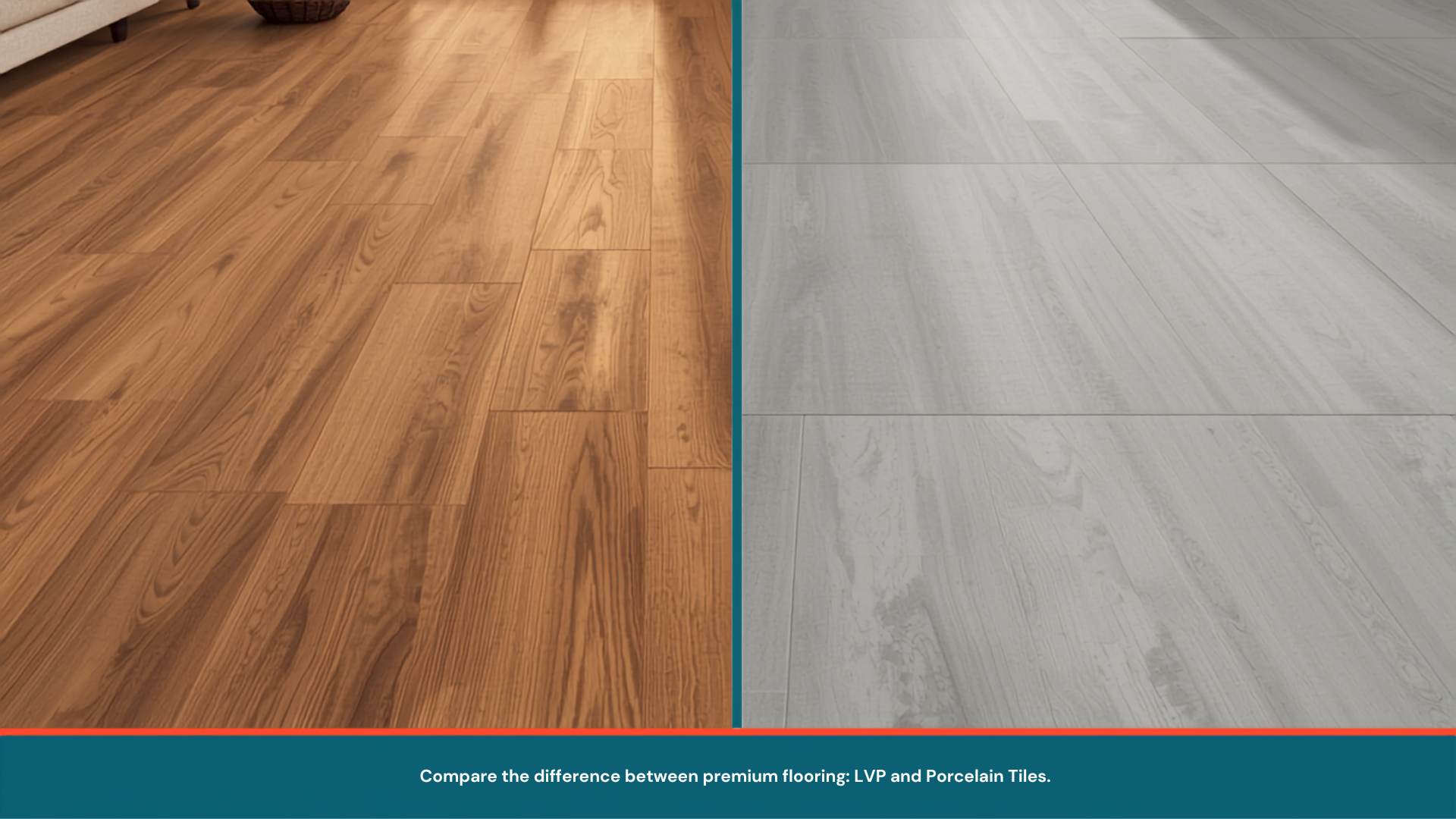
Choose tile when you want the hardest, longest-lasting surface you can buy, especially for showers, entries, and kitchens where heat, grit, and water are constant. Choose luxury vinyl plank (LVP) when you want a warmer, quieter, more comfortable floor that installs faster, usually costs less to install, and shrugs off everyday spills throughout the house. Plenty of Denton homes land on both: porcelain tile in the wet zones and LVP everywhere else. The rest of this guide shows how to decide room by room.
About this guide: Prepared by the flooring team at Smitty’s Floor Covering in Denton, TX, family owned since 1958 and the oldest family-owned floor covering business in Denton County. We sell and install both luxury vinyl and tile, so we have no reason to push one over the other. Technical figures reference ANSI tile standards and typical manufacturer specifications; always check the specific product you choose.
- Which lasts longer? Tile, often 50 years or more when installed well. Quality LVP typically lasts 10 to 25 years depending on its wear layer and traffic.
- Which is cheaper? LVP usually costs less to install and goes in faster; tile involves more labor and curing time.
- Which is better for bathrooms? Tile for showers and wet walls; either works on a bathroom floor.
- Which is more comfortable? LVP. It feels warmer and softer and is quieter underfoot.
What Is LVP, and What Is Tile?
How luxury vinyl plank is built
LVP is a layered product. On top sits a clear wear layer, measured in mils (thousandths of an inch), that takes the scratches and scuffs. Beneath it, a high-resolution print film carries the wood, stone, or tile look, and an embossed texture adds realism. The core provides stability: rigid stone plastic composite (SPC) cores are dense and dimensionally stable, while wood plastic composite (WPC) cores are a little thicker and softer underfoot. Many planks add an attached pad for sound and comfort. Our guide to luxury vinyl core materials compares SPC, WPC, and the other options in detail.
How tile is built
Floor tile is fired clay. Porcelain is made from refined clay fired at high temperatures until it is dense and absorbs 0.5 percent of its weight in water or less, the definition set by the ANSI A137.1 standard. Ceramic is slightly softer and more absorbent, which is fine for many dry floors. Glazed tiles carry a PEI rating from 1 to 5 for surface wear; residential floors generally call for PEI 3 or 4. Tile is set in mortar over a slab or a tile-ready underlayment, and the joints are filled with grout.
LVP vs. Tile at a Glance
| Factor | Luxury vinyl plank | Porcelain or ceramic tile |
|---|---|---|
| Water | Waterproof core and surface; water can still travel through seams to the subfloor | Porcelain is nearly impervious; grout needs sealing or an epoxy grout |
| Scratches and wear | Good; depends on wear layer thickness | Excellent; very hard glazed or through-body surface |
| Impact | Can dent under heavy point loads | Can chip or crack from a hard drop or a moving subfloor |
| Comfort and sound | Warmer, softer, quieter | Hard, cool, louder; pairs well with radiant heat |
| Installation | Fast; floating or glue-down | Slower; mortar and grout need curing time |
| Lifespan | About 10 to 25 years | 50 years or more |
| Repairs | Replace individual planks | Replace individual tiles; keep spares for a match |
| Best rooms | Living areas, bedrooms, kitchens, laundry, rentals | Showers, baths, entries, kitchens, sunrooms |
Tap each category below to see how the two compare on real measurements.
Tile outlasts nearly every other floor when the base beneath it is sound. LVP lifespan tracks its wear layer and how much grit it sees.
A 20 mil wear layer is a good target for busy family rooms and pets. Tile shrugs off claws and furniture feet, though a dropped cast-iron pan can chip it.
Both handle spills. Neither is a substitute for a waterproofed shower pan, and standing water under either floor still needs drying out.
LVP adds very little height, which helps with doors, appliances, and transitions. Tile needs more depth for its mortar bed.
Tile conducts heat away from bare feet, which feels great in a Texas August and chilly in January. Some LVP collections are also approved for radiant heat.
Faster installs mean less disruption. Tile rewards patience with decades of service.
Durability: Scratches, Dents, and Cracks
Tile is the tougher surface. Porcelain resists scratching from grit, pet claws, and furniture, it does not fade in sunlight, and it will not scorch if a hot pan lands on it. Its weaknesses are impact and movement: a heavy dropped object can chip a tile, and if the slab or subfloor moves, tile and grout crack. That is why proper preparation, including crack isolation over slab cracks, matters so much.
LVP resists scratches through its wear layer, and thicker is better. For busy homes, look for a wear layer of 20 mil if the budget allows. LVP can dent under concentrated weight, such as a refrigerator rolled across it or a narrow chair leg, so use furniture pads and appliance sliders. It will not crack from a dropped mug, and it is far more forgiving of minor subfloor movement.
Water Resistance: What Waterproof Really Means
Rigid-core LVP is marketed as waterproof, and the planks themselves are: water will not swell the core the way it swells laminate or wood. But water that runs across the floor can seep through seams and around the edges to the subfloor, so a burst supply line still means pulling up planks to dry things out. Our article on waterproof luxury vinyl for flood-prone areas covers what the label does and does not promise.
Porcelain tile is nearly impervious, but grout is porous unless it is sealed or made with epoxy, and discolored grout is the most common tile complaint we hear. Our guide to solving grout discoloration explains the fixes. For showers and tub walls, tile over a proper waterproofing system is the right choice; LVP is a floor product, not a shower surround.
Comfort, Warmth, and Noise
This is where LVP wins clearly. It feels close to room temperature, has a little give, and, especially with an attached pad or a quality underlayment, it is noticeably quieter. That makes it a favorite for bedrooms, playrooms, second floors, and kitchens where someone stands for long stretches. Our guide on choosing underlayment for LVP explains how pads change comfort and sound.
Tile is hard and cool. In North Texas summers, a cool floor is a feature, and in winter a rug or radiant floor heat solves the chill. Tile is also louder: footsteps, dropped keys, and dog claws all carry. If you love tile in a living area, plan on area rugs to soften the sound.
Looks and Design Flexibility
Tile offers depth that is hard to fake: real glazes, natural-stone textures, handmade-look ceramics, patterned cement looks, and large-format porcelain slabs with minimal grout lines. It also works on walls, backsplashes, and showers, so one material can carry through a bathroom.
LVP has become remarkably realistic, especially in wood looks, and it now comes in stone and tile looks too. Browse our tile-look luxury vinyl to see how close it gets, or read about stone-look luxury vinyl. If you want the real thing, our porcelain tile collection includes wood looks, stone looks, and large formats from Dal-Tile, Marazzi, and Ragno.
Which Is Right for You? Weigh Your Priorities
Move each slider to show how much a factor matters in your home. The scorer weighs general performance ratings for each floor (shown in parentheses) by your priorities.
Ratings out of 5 (LVP / tile): water 4/5, scratch and wear 3/5, comfort 5/2, quiet 4/2, budget and speed 5/2, longevity 3/5.
A starting point, not a verdict. Specific products vary, and room conditions matter as much as preferences.
Cost Factors and Installation Time
We do not publish prices because they change with the product, the room, and the prep, but the cost drivers are consistent. LVP usually costs less to install because it goes down faster: floating planks click together with no mortar or grout, and a typical room can often be finished in a day and walked on right away. Tile involves more labor: layout, cutting, mortar, grout, sealing, and curing time before heavy use.
- Preparation. Tile needs a very flat, stiff base (ANSI A108.02 calls for flatness within 1/4 inch in 10 feet for standard tile and 1/8 inch for large-format tile). Many LVP makers call for flatness within about 3/16 inch over 10 feet. Slab grinding, patching, and leveling apply to both.
- Removal. Tearing out old tile is slower and dustier than pulling up carpet or a floating floor.
- Layout and size. Diagonal and herringbone patterns add cuts and waste for both floors; large-format tile adds handling and leveling.
- Trim and transitions. Stair nosing, reducers, and thresholds add up across a house.
Use this estimator to see how much material each floor needs for a room, including a typical allowance for cuts and waste.
LVP to order: 240 sq ft (12 cartons)
Tile to order: 247 sq ft (21 cartons)
Includes 7% overage for LVP and 10% for tile.
Carton coverage varies by product; check the label. Closets, bump-outs, and stairs add more. Our free in-home measurement produces exact numbers.
For an exact figure, our free in-home measurement captures every room, transition, and stair, and our financing options can spread the cost of a larger project.
Lifespan, Repairs, and Long-Term Value
Installed well, porcelain tile can outlast the house’s cabinets and fixtures, often 50 years or more; the grout may need refreshing along the way. LVP lifespan depends on its wear layer and traffic, typically 10 to 25 years before it looks tired. Neither can be sanded or refinished, so what you buy is what you keep.
Repairs favor both in different ways. A damaged LVP plank can be replaced, easily on a floating floor near a wall and with more effort in the middle of a room or on a glue-down floor. A cracked tile can be chiseled out and replaced, as long as you saved a few spares from the original lot so the color matches. Keep a box of leftovers from either floor.
For resale, tile in bathrooms, showers, and entries reads as a premium finish. LVP is now widely accepted by buyers in living areas, kitchens, and bedrooms, especially wood looks. Our comparison of luxury vinyl and hardwood covers how LVP stacks up against real wood too.
Pets, Kids, and Allergies
Both floors are hard surfaces that do not trap dander or dust the way carpet can, so both suit allergy-conscious homes. The differences show up in daily life with pets and kids:
- Claws. Tile will not scratch; LVP with a thick wear layer holds up well, as our article on the benefits of LVP for pet-friendly homes explains.
- Accidents. Both surfaces wipe clean. On tile, unsealed grout can absorb urine and odor; on LVP, liquid left for hours can reach the seams.
- Joints and falls. LVP is easier on older dogs’ hips and on toddlers who tumble. Tile is harder on both.
- Traction. Look for textured LVP and tile with a suitable wet DCOF. Our guides to tile slip ratings and luxury vinyl safety features explain what to look for.
North Texas Factors: Slabs, Clay Soil, Heat, and Sun
Most Denton County homes built in recent decades sit on concrete slabs, and our expansive clay soils can shift those slabs over time. That matters for both floors. Tile over a slab should get a crack isolation membrane wherever the concrete is cracked, so slab movement does not telegraph into the tile. Floating LVP tolerates minor movement better, which is one reason it is so popular here. Slab moisture is the other consideration; our guide to installing luxury vinyl over concrete slabs explains testing and prep.
Heat and sun are the Texas twist. Large west-facing windows can heat an LVP floor enough to make it expand and, with some products, fade. Close blinds during peak afternoon sun, and consider glue-down LVP or tile for sunrooms and rooms with walls of glass. Tile, meanwhile, stays cool and never fades, one reason it has been a Texas favorite for generations.
Room-by-Room: LVP or Tile?
Tile handles heat, dropped knives, and decades of traffic; LVP is kinder to feet during long cooking sessions and to dropped glasses. Pick tile if you want it to outlast the cabinets; pick LVP for comfort and a quicker install.
Porcelain is the classic choice and pairs with heated floors; waterproof LVP is warmer and faster to install. Seal grout or choose epoxy grout if you go with tile.
Showers and tub surrounds need tile (or another wall system) over a proper waterproofing layer. LVP is a floor product and does not belong on wet walls.
Warmth, quiet, and comfort win in the rooms where you relax and sleep. Wood-look LVP delivers the hardwood look with spill protection.
Tile is the safest bet around leaky washers; LVP works if you watch for leaks, since water can reach the subfloor through seams. A drain pan under the washer helps either way.
Grit, mud, and wet shoes make porcelain the heavyweight choice at the door. A textured LVP is a quieter alternative if the entry opens into living space.
Direct sun and heat are hard on floating vinyl. Tile stays cool and will not fade; if you prefer vinyl, choose a glue-down product rated for the conditions.
Fast installs, easy plank replacement, and good water resistance make LVP a landlord favorite. Tile is a longer-term investment for owner-occupied homes.
Our roundup of the best tile options for North Texas kitchens and bathrooms goes deeper on the wet rooms, and our luxury vinyl overview and tile overview cover each category’s basics.
See both side by side. Browse our full luxury vinyl selection and tile catalog, then compare samples in our showroom.
Get a Free EstimateLVP vs. Tile FAQs
Is LVP better than tile?
Neither is better everywhere. LVP is better for comfort, quiet, installation speed, and budget; tile is better for longevity, scratch and heat resistance, and wet walls. Many homes use tile in wet zones and LVP in living spaces.
Is LVP cheaper than tile?
Usually, yes, mainly because LVP installs faster with no mortar, grout, or curing time. Premium LVP can cost as much as mid-range tile, so compare installed costs for your specific products and room.
Which lasts longer, LVP or tile?
Tile. A properly installed porcelain floor can last 50 years or more, while quality LVP typically lasts 10 to 25 years depending on its wear layer and traffic.
Is LVP or tile better for a bathroom?
For shower walls and tub surrounds, tile. For the bathroom floor, both work: porcelain for longevity and radiant heat, waterproof LVP for warmth and a faster install.
Which is better for dogs?
Tile resists scratches best; LVP is warmer, quieter, and easier on joints, and a 20 mil wear layer holds up well. Either needs prompt cleanup of accidents.
Can LVP be installed over tile?
Often, yes. Many rigid-core LVP products can float over existing tile that is flat, sound, and firmly bonded, sometimes after deep grout lines are filled. Check the manufacturer’s flatness and substrate requirements first.
Does LVP look cheaper than tile?
Not anymore, for the most part. Modern LVP uses high-resolution prints and embossed textures that look convincing, especially in wood looks. Up close, real tile still shows more depth in stone and glazed finishes.
Which is easier to clean?
LVP, slightly, because it has no grout lines. Both clean with a vacuum and a damp mop using a pH-neutral cleaner; tile grout benefits from periodic sealing.
Compare LVP and Tile in Our Denton Showroom
The fastest way to decide is to stand on both. Visit our showroom at 1815 N Elm in Denton, where our in-house design consultants can help you compare luxury vinyl and tile for each room, and our installation team handles both. See why families trust us by reading our customer reviews. We serve Denton, Corinth, Hickory Creek, Krum, and Ponder, as well as Argyle, Aubrey, Flower Mound, Lake Dallas, Lewisville, and nearby Denton County communities.
Still Deciding Between LVP and Tile?
Tell us about your rooms, and we’ll recommend the right floor for each one.
Request Your Free Estimate →


