

You walk across a newly installed laminate floor, and instead of the solid, quiet feel you expected, every step echoes with a faint hollow click. The planks look beautiful — the wood-grain texture is exactly what you picked out — but something feels off. That "something" almost always traces back to what's underneath: the underlayment.
Underlayment is the layer between your subfloor and the finished flooring, and it's one of the most misunderstood parts of any flooring project. It never gets seen, rarely gets discussed during the selection process, and yet it shapes how your floor feels underfoot, how much sound travels through your home, and how many years you get out of your investment.
What Underlayment Actually Does
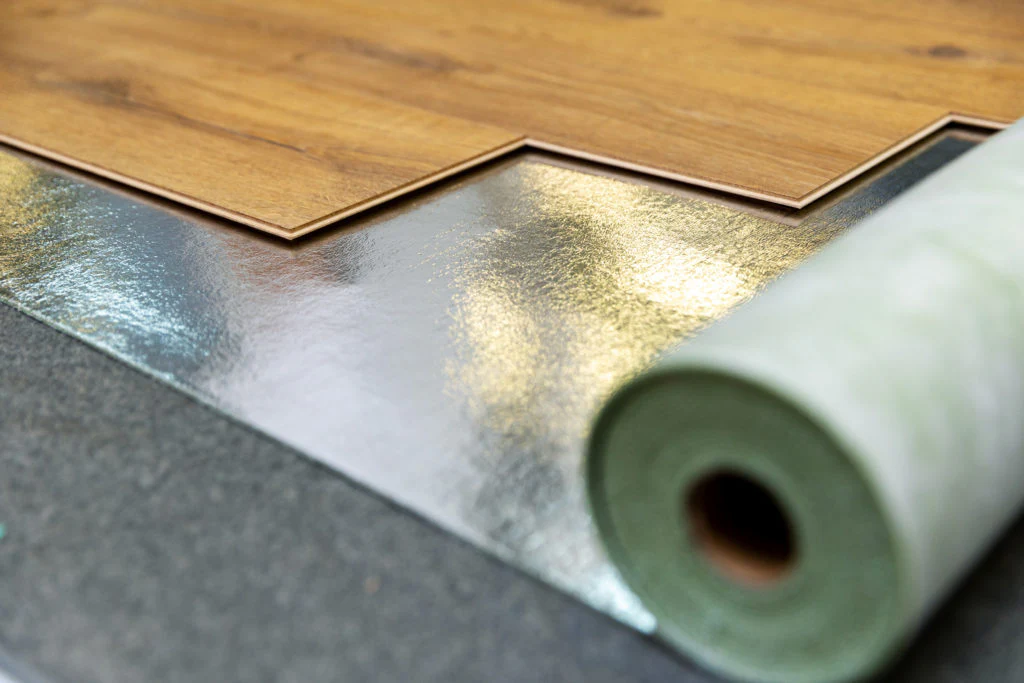
Most people think of underlayment as a thin foam sheet that gets rolled out before the planks go down — and technically, that's a start. But the right material does three distinct jobs at once.
First, it provides cushion and comfort. Laminate and luxury vinyl are rigid surfaces by design. Without a forgiving layer beneath them, every step transfers impact straight back into your joints and feet. A quality underlayment absorbs that energy, creating a softer, more resilient feel that makes standing in the kitchen or walking down a hallway noticeably more comfortable.
Second, it controls sound. Hard surface flooring reflects noise — footsteps, dropped objects, the click of pet nails. The pad acts as a decoupler, breaking the pathway that sound vibrations travel from the floor into the subfloor and, in multi-story homes, into the rooms below. Some products are engineered specifically for acoustic performance, reducing both impact noise and ambient echo.
Third, and most critically for longevity, it protects the floor's locking system. Modern laminate planks connect via precision-milled click-lock edges that are strong but unforgiving. If the subfloor has even minor dips or ridges, those joints flex microscopically with every step. Over months and years, that repeated stress loosens the connections and wears down the edges — and once a locking mechanism fails, individual planks begin to separate. The right underlayment bridges small imperfections and keeps the entire surface supported.
How the Wrong Choice Shortens Floor Life
The most common mistake we see isn't choosing a cheap underlayment — it's choosing one that's incompatible with the flooring going on top of it.
Thickness matters in ways that aren't obvious. Laminate manufacturers specify a maximum pad thickness for their products, and exceeding it doesn't give you extra cushion — it creates too much vertical give. When a heavy piece of furniture compresses an overly thick layer, the locking joints around it pull apart. We've walked into homes where beautiful flooring installed just a year earlier had developed gaps at the seams, and the culprit was consistently an over-spec underlayment.
Moisture protection is non-negotiable in our climate. Homes across Denton County sit on concrete slabs that release water vapor year-round, especially during humid Texas summers. Without a proper vapor barrier — either built into the underlayment or installed separately — that moisture migrates into laminate cores and causes swelling, cupping, and delamination. Luxury vinyl resists water better, but trapped moisture underneath any floor breeds mold and compromises adhesives.
Attached padding complicates the equation. Many luxury vinyl products now come with a pre-attached underlayment layer, which seems convenient. But adding an additional pad underneath those planks voids most manufacturers' warranties. The floor needs just enough give to feel comfortable without becoming unstable. Our team evaluates the subfloor condition, the specific product's requirements, and the manufacturer's guidelines before recommending what goes underneath — because getting any one of those factors wrong means replacing the entire floor.
Matching Underlayment to Your Flooring
Laminate and luxury vinyl share surface-level similarities — both mimic wood and stone realistically, both install as floating floors — but their underlayment needs diverge in important ways.
For laminate, you need a combination of vapor protection and acoustic dampening. Most laminate-specific underlayments include a moisture-blocking film laminated to a dense foam or fiber core. This dual-purpose design prevents ground moisture from reaching the planks while quieting footfall. In upstairs installations, adding a premium acoustic layer becomes especially important — laminate transmits sound through wood subfloors more readily than through concrete.
For luxury vinyl, the requirements depend on the product's construction. Rigid core planks with an SPC (stone plastic composite) core are dimensionally stable and often don't require additional cushioning beyond what's already bonded to the plank. Flexible vinyl, on the other hand, telegraphs every subfloor irregularity and needs a thin, high-density pad to prevent indentations from furniture and appliance weight. The common thread: never assume one underlayment works for both.
Getting this right starts with understanding what you're actually working with. Subfloor condition, humidity levels, and the specific flooring product all factor into the recommendation. Browse the different structures and styles in our laminate catalog and compare them with rigid core options in our luxury vinyl collection — the product pages give you a clear picture of what each type requires underneath.
The Professional Assessment Advantage
What you can't see in your subfloor matters more than what you can. Hairline cracks, moisture vapor emission rates, and subtle slope changes that escape a casual glance all affect how the underlayment performs over time. A professional measurement accounts for door clearances, transition heights to adjoining rooms, and appliance spacing — all of which shift once you factor in the combined thickness of plank and pad.
Proper installation sequencing matters too. The underlayment goes down first, seams taped against moisture intrusion, and then the planks follow with an expansion gap at every perimeter. Skipping any one of those steps — or installing products in the wrong order — creates problems that compound over the floor's entire life. Our installation guide covers the full process, from acclimation through the final walk-through, so you know what to expect before the first roll gets unrolled.
At the end of the day, underlayment is an investment in how your floor feels today and how it holds up ten years from now. It's the difference between a floor you notice only when something squeaks and one that quietly does its job season after season. Getting the right product under your feet comes down to matching the material to your specific situation — and that's where having someone who's done it thousands of times makes all the difference. When you're ready to start, request a free estimate and we'll help you sort through the options with your home's actual conditions in mind.


