

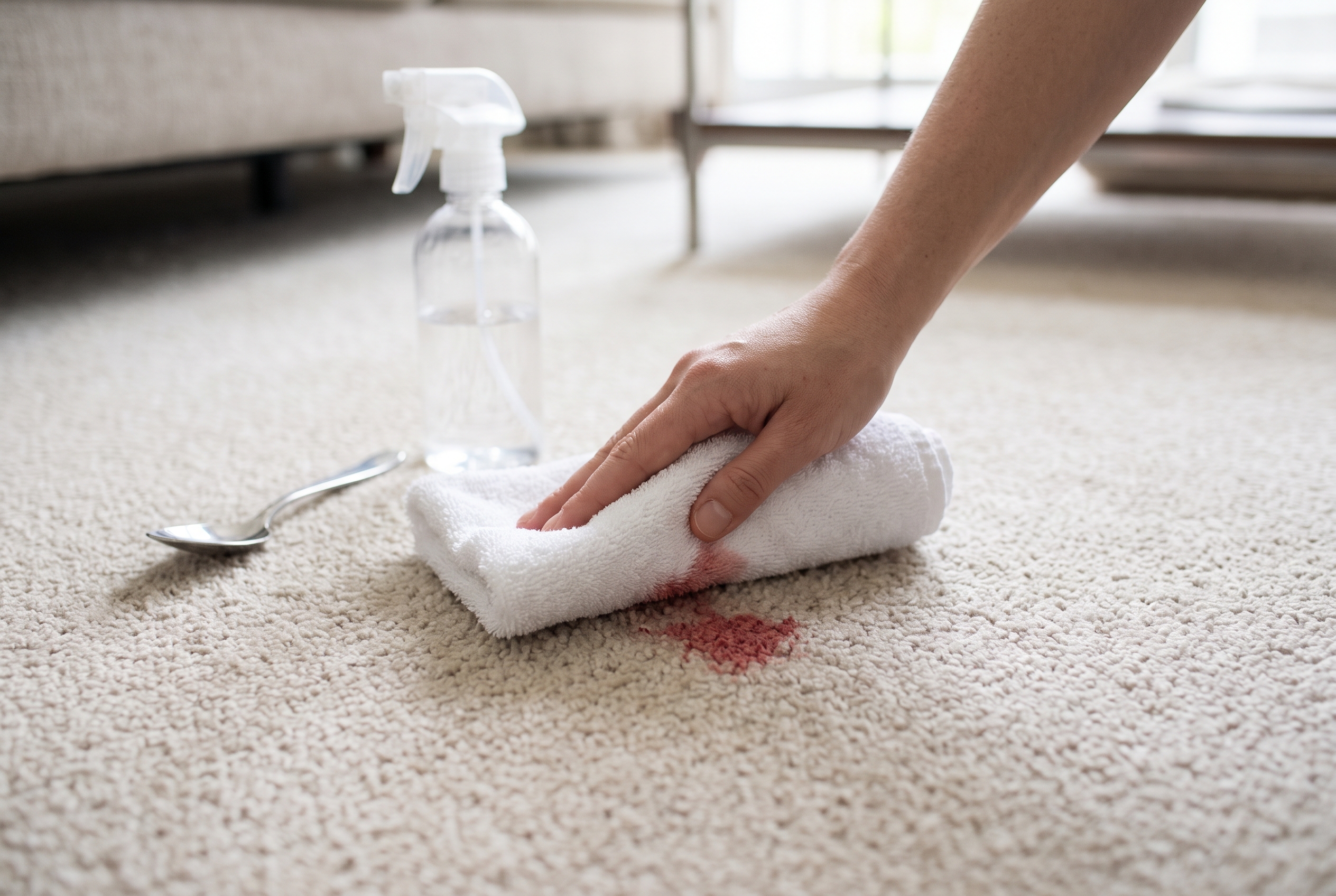
Most fresh spills come out of carpet with plain white towels, cool water and a weak solution of liquid dish detergent, blotted from the edge of the spot toward the middle and rinsed. The stain and the fiber change the rest. Grease needs a solvent, red drinks behave like dye, pet accidents need an enzyme cleaner, wool can't take ammonia or bleach, and a spot that turned lighter has lost its color, which no cleaner brings back.
| Stain type | Examples | First thing to use |
|---|---|---|
| Drinks | Coffee, tea, soda, juice | Detergent solution, then vinegar solution |
| Dyes | Red wine, fruit punch, sports drinks | Detergent solution, right away |
| Protein | Blood, vomit, milk, egg | Cold water, then detergent solution |
| Pet accidents | Urine, feces | Paper towels, cool water, enzyme cleaner |
| Oily | Grease, butter, makeup | Dry-cleaning solvent on a cloth |
| Wax and gum | Candle wax, gum, crayon | Ice or scraping, then solvent |
| Ink and polish | Marker, nail polish | Nail polish remover on a cloth |
| Mud and rust | Red clay, rust marks | Dry vacuuming, then vinegar for rust |
| Color loss | Bleach, acne cream, plant food | A patch or color repair |
What Should You Do in the First Few Minutes After a Spill?
Blot up as much of the spill as you can before you clean anything. The less that soaks into the yarn, the backing and the pad, the less there is to come back later.
- Lift solids first. Scrape up food, vomit or anything thick with a rounded spoon, and vacuum up dried bits once they're broken up.
- Blot liquids with a dry white cloth or plain white paper towels. Press down, move to a dry part of the towel as it takes up color, and keep going until the carpet is nearly dry. Printed towels can transfer their dye to wet carpet.
- For a big spill, lay a thick stack of towels on it and stand on them, or pull it up with a wet/dry vacuum.
- If you need to dilute what's left, use cool or lukewarm water, never hot. Heat sets blood, milk and urine into the fiber.
- Test anything you plan to use on a hidden spot, like the back of a closet. If color comes off on the cloth or the carpet changes, pick something else.
Blot instead of rubbing, and keep brushes away from the spot. Rubbing and scrubbing fray the tips of the yarn and change its texture, and they push the spill deeper and wider.
A small spot kit saves the first few minutes. Keep a stack of white towels, a rounded spoon, a spray bottle for plain water, liquid dish soap and white vinegar together in one place, away from the cleaning products you use on counters and tile.
How to Remove Most Carpet Stains With a Mild Detergent Solution
Most water-based spills come out with a weak detergent solution, worked in with a cloth, blotted and rinsed. The Carpet and Rug Institute (CRI) gives the recipe: a quarter teaspoon of liquid dishwashing detergent in a cup of lukewarm water, and never stronger.
Use dish soap made for washing by hand. Laundry detergent can carry optical brighteners that dye the fiber, and many dishwasher detergents carry bleach that strips color.
- Mix 1/4 teaspoon of liquid dish detergent into 1 cup of lukewarm water.
- Dampen a white cloth with the solution. Don't pour it on the carpet.
- Work it in gently from the edge of the spot toward the middle, let it sit a few minutes, then blot.
- Keep going while the spot keeps transferring to the cloth. Several rounds are normal.
- Rinse with plain water from a spray bottle and blot, two or three times. Soap left in the pile pulls in dirt and turns into a dark spot.
- Lay a stack of white paper towels on the spot, set something flat and heavy on top, and leave it until dry.
When the detergent stops lifting the stain, the next step depends on what spilled. White vinegar, 1 cup in 2 cups of water, helps with coffee, tea, rust and many drink stains, and it also takes the edge off any detergent left behind. A tablespoon of household ammonia in a cup of water is a later step for blood, wine and several other stains. Ammonia can change carpet color, though, so test it first and skip it on wool and on pet accidents.
Rinse between solutions and never mix them.
Carpet makers don't all use the same recipe. Among the carpet brands we carry, Godfrey Hirst's guide treats food and drink with warm water first. Its next step is a teaspoon of mild laundry detergent in a liter of warm water, and it advises against supermarket spot cleaners. If a maker's care guide came with your carpet, follow its steps, since those are the ones tied to the maker's warranty.
Which Cleaners Are Safe on Your Carpet's Fiber?
It depends on the fiber, so find out what yours is before you reach for anything stronger than the detergent solution. The fiber is listed on the original paperwork, on the label of a leftover piece and on the maker's page for the line.
| Fiber | Strong point | Weak spot |
|---|---|---|
| Nylon | Wears well and springs back | Red dyes and bleach |
| Polyester | Resists water-based spills | Oily spills |
| Olefin | Color locked into the fiber | Oily spills and heat |
| Triexta | Stain resistance built into the fiber | Cleaners its maker doesn't list |
| Wool | Hides soil and feels soft | Ammonia, bleach and hot water |
Wool is a protein fiber, like hair. Bleach dissolves it, alkaline cleaners such as ammonia damage it and can shift its color, and hot water with rubbing can felt it. On wool, stick to the detergent solution, rinse well and buy only spot cleaners labeled safe for wool.
Nylon takes dye the same way red fruit punch does, which is why a red spot on nylon can fade without fully disappearing. Polyester and olefin shrug off most water-based spills but hold onto oil, so a greasy spot takes several rounds of solvent. Olefin also softens under heat, so keep irons and hot tools off it.
Fibers that are solution-dyed, as olefin and some polyesters are, carry their color all the way through. They resist fading and bleach spots far better than fibers dyed after they're made, though bleach is still best kept off any carpet. Triexta resists stains by its makeup, so the protection doesn't wear off, but its maker's care guide is still the one to follow.
How to Remove Specific Carpet Stains
Identify the carpet stain before you treat it, because the wrong cleaner can set it. For every stain, start with the gentlest step, rinse between solutions, and move to the next one only when the last stops lifting color.
How to Clean Coffee, Tea, Soda and Juice From Carpet
Coffee and tea stain with tannins, the brown plant compounds that also color tea cups, and soda and juice add sugar. Blot, then use the detergent solution. If a brown mark remains from coffee or tea, follow it with the vinegar solution, then blot and rinse.
Rinse more than you think you need. Coffee with sugar, soda and juice leave sugar behind, and that sticky film catches dirt until it looks like a new stain a week later. Grape juice and fruit punch carry dye on top of the sugar, so treat them as dye stains if the color doesn't move with the first rounds.
How to Treat Red Wine, Fruit Punch and Other Dye Stains
Red wine, fruit punch, sports drinks and colored frosting stain with dye, and dye bonds to the fiber more firmly the longer it sits. Blot it right away with cool water. Then work through the detergent solution and the vinegar solution, rinsing between them.
If pink remains, a spot removal kit made for carpet is the next step, used just as its directions say. When a kit has a separate stain-resist step, hold that step until the stain is completely gone, because it can lock in what's left. The last home step for wine and fruit punch is the ammonia solution, tested first and never used on wool.
Keep heat off a dye stain, including a hair dryer or a steam cleaner, until the color has stopped moving, since heat helps dye bond. What's left after these steps is dye fixed in the fiber, and on nylon a pink shadow may stay.
How to Remove Blood, Vomit and Other Protein Spills
Blood, vomit, milk and egg are protein, and heat cooks protein into the fiber the way it sets an egg. So use cold water, never hot. Scrape up what you can, blot, then use the detergent solution and rinse.
For blood that's still there, the next steps are plain water, then the ammonia solution on synthetic carpet. For vomit, follow the detergent with the vinegar solution, then rinse, and use the ammonia solution only if a mark remains. An enzyme cleaner helps with dried protein that the solutions won't lift, because the enzymes break the protein down.
How to Clean Up Pet Urine and Accidents on Carpet
Pull out as much pet urine as you can before it dries. Lay a thick layer of paper towels on the spot, cover it with newspaper and stand on it for about a minute, then repeat with fresh towels until the spot is barely damp. Rinse with cool water and blot, or pull the water out with a wet/dry vacuum.
Then use an enzyme cleaner made for pet urine, following its label, and let it dry. Skip the vinegar and ammonia steps for a pet accident, because their smell can draw a pet back to the same spot. Never steam-clean urine, since heat sets both the stain and the smell. An enzyme cleaner works best on a spot that hasn't already had other cleaners on it, and a black light in a dark room shows old spots you can't see.
A big accident, or the same spot used again and again, soaks through to the pad, and that's where lasting pet odor in carpet comes from. Urine that has soaked the pad may mean replacing that section of carpet and pad. For feces, scrape and blot, then use the detergent solution, rinse and finish with the enzyme cleaner.
How to Lift Grease, Oil, Butter and Makeup
Grease, oil, butter and makeup don't mix with water, so water-based solutions just push them around. Scrape off what you can, blot, then use a non-flammable dry-cleaning solvent or spot remover. Put it on a cloth, never straight on the carpet, because solvent that reaches the backing can dissolve the latex that holds the carpet together.
Follow the solvent with the detergent solution to remove it, then rinse. Polyester and olefin hold onto oil, so expect a few rounds. For lipstick and other makeup, start with nail polish remover on a cloth, then the solvent and the detergent. Oil left in the pile attracts dirt, so a greasy spot that looks fine today can darken in a week if it isn't fully rinsed.
How to Remove Ink, Marker and Nail Polish From Carpet
Ink, marker and nail polish are color carried in a solvent, so they need a solvent to come out. Washable ink is the exception and often lifts with the detergent solution alone. Felt-tip marker and nail polish need nail polish remover first, on a cloth and blotted, then a dry-cleaning solvent, then the detergent solution to clear the residue.
Use a clear remover without lanolin, and test it first, since acetone can affect some dyes. Blot from the outside in and change cloths often, because a cloth loaded with ink spreads it. Permanent ink is different again: home methods tend to spread it, so blot up what's wet and stop there.
How to Get Candle Wax, Gum and Crayon Off the Pile
Wax, gum and crayon soften with heat and turn brittle with cold, so cold is the safer tool. For gum, harden it with ice cubes in a plastic bag, shatter it and pick the pieces out of the yarn, then use a solvent on a cloth for what's left. For candle wax, let it harden, break off what you can and treat the rest with nail polish remover and then a solvent. Crayon comes out with a solvent, then the detergent solution.
You'll see advice to melt wax out with an iron over a paper bag. On synthetic carpet, heat can melt or flatten the yarn, so scraping and a solvent are the safer route. Colored candle wax and crayon can leave dye behind once the wax is gone, and that leftover color takes the dye steps.
How to Clean Mud and Red Clay Out of Carpet
Mud and red clay come out best dry, because wet mud smears deeper into the pile. Let it dry completely, break it up and vacuum slowly from several directions. Then use the detergent solution, rinse and dry.
Red clay is rich in iron, and it can leave a rusty tint after the mud is gone. The vinegar solution is the first step for rust, and it often lifts that tint over a few rounds. A stubborn rust mark needs a rust remover made for carpet, and Godfrey Hirst's guide doesn't recommend applying one at home. A mat at each outside door keeps most of the clay off the carpet in the first place.
How to Treat Mustard and Curry Spills
Mustard and curry get their yellow from turmeric, a strong natural dye. Scrape off what you can without pressing it in, blot, then use the detergent solution and the vinegar solution, rinsing between them.
Turmeric can take several rounds and still leave a faint yellow shadow, especially on light carpet. Keep heat off it while you work, and finish with a plain-water rinse and a towel under a weight. A shadow that won't lift after that is dye in the fiber, the same as a red drink.
How to Remove Latex and Oil-Based Paint From Carpet
Latex paint is water-based while it's wet, so act before it dries. Blot, then use the detergent solution with cool water, rinsing often. Dried latex takes the same steps with more patience, softening the film a little at a time, and the ammonia solution comes after plain water if a mark remains.
Oil-based paint needs nail polish remover, then a solvent, then the detergent solution, each on a cloth. Keep any thinner or solvent off the backing. Scrape a dried paint drip as much as you can before using anything wet, since every bit you lift dry is a bit you don't have to dissolve.
How to Get Old or Set-In Stains Out of Carpet
Many old carpet stains come out at least partway, and some come out completely. The work is the same as for a fresh spill, with more rounds and more patience.
- Vacuum the spot to lift loose soil off the top.
- Work out what the stain was from its color, its feel and where it is. A brown spot near the coffee table is a different job from a yellow one by the back door.
- Mist it with the detergent solution, let it sit a few minutes to soften, then blot.
- Repeat over several rounds, rinsing as you go, then move to that stain's next solution.
- For old urine, food or vomit, finish with an enzyme cleaner and give it the full time on its label.
- Stop when the cloth picks up carpet color instead of stain color, because at that point you're removing dye.
A stain that's years old may only lighten. A brown spot that keeps coming back is often residue rather than the original stain, and plain-water rinsing fixes that.
Some old stains need more than spot cleaning. Professional hot-water extraction rinses out soil and residue that a spray bottle and towels can't reach.
Why Do Carpet Stains Come Back After Cleaning?
Carpet stains come back after cleaning for two reasons: wicking and residue. Both show up a day or two after the spot looked clean.
Wicking happens when a spill soaked into the backing or the pad. As the top of the carpet dries, moisture climbs back up the yarn and brings the stain with it. Use less liquid, blot harder, and finish with a thick stack of white towels under a weight overnight, with a fan running.
Residue is soap or sugar left in the pile. It catches dirt from shoes, and the spot darkens again. Rinse with plain water from a mist sprayer several times, blotting after each rinse, until no suds or stickiness remain.
A brown ring that shows up after a spot was wet is usually soil drawn up from the backing as the carpet dried, or soap left in the yarn. Blot the ring with plain water, press it with towels under a weight and dry it fast with a fan. A pet spot that keeps returning means urine is still in the pad.
Do Homemade Carpet Stain Removers Work?
Yes, the simple ones do. The detergent, vinegar and ammonia solutions are homemade, and they're CRI's own recipes. The trouble starts with stronger mixes and folk remedies.
The homemade spray worth keeping is the detergent solution, mixed fresh in a labeled spray bottle, with a second bottle of plain water for rinsing. Mist the spot rather than soaking it.
Baking soda absorbs a fresh spill and some odor, but every bit has to be vacuumed out, or it leaves a white haze. Vinegar and baking soda together mostly cancel each other out, and the fizz is the two reacting with each other. Club soda is mostly water and works about as well as plain water.
Hydrogen peroxide is a mild bleach, and it can lighten the carpet's dye along with the stain. It isn't in CRI's recipes, so use it only if your carpet maker's guide calls for it. Chlorine bleach doesn't belong on carpet at all, and the CDC warns never to mix household bleach with any other cleaner, because the vapors can be dangerous to breathe.
The most common home mistakes are too much soap and too much water. Extra soap leaves residue, and using too much water soaks the pad, where the stain waits to wick back up.
How to Choose a Store-Bought Carpet Stain Remover
The right store-bought carpet stain remover depends on your carpet and the stain, so start with your carpet maker's care guide. After that, look for CRI's Seal of Approval, which goes to cleaning products that pass lab tests for removing soil without harming the carpet's look.
Read the label for the word carpet, for your fiber, and for rinsing directions. For pet accidents, pick an enzyme cleaner made for pet urine, and for a kit with a stain-resist step, use that step last.
Whatever you buy, test it in a closet, use less than you think and rinse it out. More product doesn't lift more stain, and what stays behind attracts soil.
Which Carpet Stains Can't Be Removed, and What Can Be Done?
A spot that's lighter than the rest of the carpet, or a different color, has lost its dye, and no cleaner puts dye back. Bleach does it, and so do acne creams with benzoyl peroxide, plant food, drain openers, and oven, tile and mildew cleaners. Some of these can dissolve the fiber as well.
Dye stains that have bonded to nylon and burns behave the same way. The fixes are a repair, a cover-up or new carpet.
HomeAdvisor's carpet repair cost guide puts professional color repair, where a specialist dyes the spot to match, at about $1.50 to $2.50 a square foot, or about $100 to $600. A patch runs about $150 to $250, and repairs for stains, bleach spots or sun damage average $125 to $250. Pet damage runs $150 to $1,000, depending on whether the pad and subfloor need work. Replacing the damaged carpet, removal included, runs about $780 to $2,810.
A patch is only as good as the carpet it's cut from. A matching piece comes from carpet saved at installation, or from a closet floor where a cut won't show. Keep a piece about 2 feet by 3 feet for repairs, and when we install carpet, you can ask our crew to set usable leftover carpet aside.
A rug works well over a single spot in a seating area or under a table. When spots are many and the carpet is worn too, it's one of the signs it's time to replace the carpet.
How Stain Protection and Stain Warranties Work
Most carpet is treated with a stain-resistant finish at the mill, and that finish wears with traffic and cleaning. Some fibers resist stains by how they're made, such as solution-dyed fibers and triexta, so their protection doesn't wear off.
Each carpet carries its own set of warranties, listed in its paperwork and on the label of the sample. In general, coverage centers on food and drink spills cleaned the way the maker says. Damage from the wrong cleaners, color loss from household chemicals and other non-food substances, and treatments added after installation are usually excluded.
Many warranties also ask for proof of professional hot-water extraction on a schedule, so keep the receipts. Check the warranty before you spray a store-bought protector on new carpet, since an added treatment can void coverage.
How to Choose Carpet That Resists Stains
The best stain-resistant carpet depends on what your household spills, but solution-dyed fibers and triexta resist staining best. Nylon with a strong stain treatment wears best in busy rooms, and polyester shrugs off water-based spills. Mid-tones, flecks and patterns hide what gets past any fiber.
The Fiber Group filter in our catalog pulls up triexta carpet, including Mohawk Flooring lines such as Pure Comfort and Thoughtful Elegance. With dogs or cats in the house, a shorter, tighter pile cleans more easily than a shaggy one, and the same carpet for homes with pets also needs a strong stain treatment.
How We Help When a Stain Won't Come Out
At Smitty's Floor Covering, we sell and install carpet from Mohawk Flooring, Godfrey Hirst, Aladdin Commercial, BPI Prestige and Kane, and our family has been putting floors in Denton homes since 1958. When stains have taken over a room, we measure it at the free in-home measurement and price new carpet in a fiber that stands up to what your household spills.
Our rug binding service can turn a larger leftover piece into a custom area rug for a spot that needs covering. Bring a cut piece or a photo of the stained room to our Denton showroom, and we'll pull carpet samples in fibers that hold up to the same spills.
Questions About Carpet Stains
Can You Use a Carpet Cleaning Machine on a Fresh Stain?
Yes, a carpet cleaning machine helps on a fresh stain for pulling out liquid and rinse water, as long as it isn't heating the spot. A small hand extractor or a wet/dry vacuum is useful after you've blotted a pet accident or a big spill. Use cool water in it, and keep steam and heat away from urine, blood and other protein stains, which heat sets.
How Long Should a Spot Cleaner Sit on Carpet?
That depends on the cleaner: the detergent, vinegar and ammonia solutions need a few minutes, then a blot, repeated while the stain keeps moving to the cloth. An enzyme cleaner needs the time on its label, often longer, because the enzymes have to break the stain down before you blot. Leaving any cleaner to dry in the carpet only adds residue.
Can You Use a Hair Dryer to Dry a Cleaned Spot?
Yes, on a low setting. Godfrey Hirst's guide allows a hair dryer to speed drying as long as the spot doesn't overheat. Blot first and press with towels under a weight, then dry, and stay off the spot until it's dry. Skip the dryer on dye and protein stains until they're fully out, since heat can set what's left.
Getting a Room Measured for New Carpet
A spot that has lost its color, or a room with too many of them, is a flooring question more than a cleaning one. We'll measure the room and price new carpet in a fiber that resists what your household spills. Start with a free in-home estimate.


